In-House BIM team vs outsourced talent: A real cost nreakdown for 2026

This article builds that full picture, role by role, and compares it against the nearshore alternative for US and Canadian firms considering both options.
The page features a clean layout with key sections like 'What Employer of Record means in practice,' 'Why this matters,' and a section detailing EOR coverage. A dedicated form titled 'REQUEST AN EOR CONSULTATION' is prominent on the right, enabling visitors to request information. The BetterPros logo and main website navigation links are visible at the top and bottom."

When architecture and engineering firms evaluate whether to build an in-house BIM team or work with outsourced talent, the conversation usually starts with salaries. It rarely ends there.

The headline salary figures for BIM modelers, coordinators, and managers are easy to find. What is harder to quantify is everything that surrounds them: the recruiting cost, the onboarding period, the software licenses, the hardware, the overhead allocation, and the fixed cost the firm carries through slow periods. When all of it is on the table, the real cost of an in-house BIM team looks significantly different from what the job postings suggest.

What the in-house BIM team actually consists of

The composition of a BIM team varies by firm size and project complexity, but for most US architecture firms with active multi-discipline projects, the functional team covers three tiers.

BIM modeler / technician: Creates and maintains Revit models from direction provided by a project lead or coordinator. Handles sheet production, view setup, family placement, and model updates. The production engine of the team.

BIM coordinator: Manages the BIM workflow across disciplines. Runs clash detection in Navisworks, coordinates model inputs from architecture, structure, and MEP, manages worksets, enforces standards, and produces coordination reports. The connective layer between production and project management.

BIM manager: Develops and maintains firm-wide BIM standards, templates, and processes. Oversees multiple projects simultaneously, manages software and license strategy, and interfaces with clients and contractors on BIM execution plans. A leadership and standards role, not a production role.

Not every firm needs all three. Small firms with fewer than 20 staff often combine the modeler and coordinator functions into one role. Larger firms running complex multi-discipline projects need the full tier structure. The cost analysis below covers each role independently so firms can model their own configuration.

In-house BIM team: the full cost by role

Using 2026 compensation data from ZipRecruiter, Glassdoor, Salary.com, and Indeed, and applying a standard 40% employer burden (payroll taxes plus benefits), the fully burdened cash cost per role looks like this:

Role Base compensation Fully burdened cash cost Effective hourly
BIM modeler / technician $65,000 to $84,000/yr $91,000 to $118,000/yr $44 to $57/hr
BIM coordinator $73,000 to $97,000/yr $102,000 to $136,000/yr $49 to $65/hr
BIM manager $90,000 to $128,000/yr $126,000 to $179,000/yr $61 to $86/hr

These figures represent cash cost only: base salary plus employer-paid taxes and benefits. They do not include overhead allocation, software, hardware, or recruiting. Each of those adds a meaningful layer.

The hidden costs most firms underestimate

Recruiting

Domestic staffing agencies charge 15 to 25% of first-year compensation as a placement fee. For a BIM coordinator at $78,000, that is $11,700 to $19,500 before the person starts. Firms that recruit directly still spend 3 to 6 weeks of project lead and principal attention on screening, interviewing, and decision-making. In tight markets, vacancy periods for qualified BIM coordinators run 45 to 60 days, during which the firm is either absorbing the capacity gap or diverting work to more expensive roles.

Onboarding and ramp time

A new BIM team member typically reaches full output after 4 to 8 weeks of working inside the firm's Revit templates, documentation standards, and coordination processes. During that period, a project lead is spending time on supervision and correction that would otherwise go to billable work. That cost is real and never appears on any HR report.

Software licenses

A full Autodesk AEC Collection license, which covers Revit, Navisworks, AutoCAD, and the broader toolset, runs approximately $3,400 to $4,200 per user per year depending on contract structure and volume. For a three-person BIM team, that is $10,200 to $12,600 per year in software alone, before any project-specific tools or add-ons.

Note: this is a cost that applies specifically to in-house staff. LATAM contractors working through BetterPros provide their own hardware and equipment. Software licenses and Autodesk environment access are provided by the client firm for both in-house and nearshore staff, so the software cost is comparable in both models. What disappears entirely with nearshore is the hardware cost.

Hardware and workstation provisioning

A production-grade workstation for BIM work costs $2,500 to $4,500 per person, depending on specifications. Firms typically replace workstations every 3 to 5 years, which translates to $500 to $1,500 per person per year amortized. For a three-person team, that is $1,500 to $4,500 per year in hardware that disappears entirely with a nearshore model, since LATAM contractors provide their own equipment.

Overhead allocation

Architecture and engineering firms carry an overhead rate of 150 to 162% of direct labor costs, according to the Deltek Clarity A&E Industry Study. At that rate, every dollar of direct labor on a BIM team member's salary carries $1.50 to $1.62 in indirect costs: principal non-billable time, administrative staff, rent, utilities, and firm-wide overhead. This is what the firm must generate in revenue to break even on each production seat before a single dollar of profit.

Fixed cost during lean periods

Every full-time BIM team member is a fixed cost that the firm carries through slow periods, project delays, and demand shifts. A team sized for peak project load is expensive during lulls. A team sized for average load creates delivery pressure every time work surges. The in-house model has no flexibility in either direction without the disruption of hiring or layoffs.

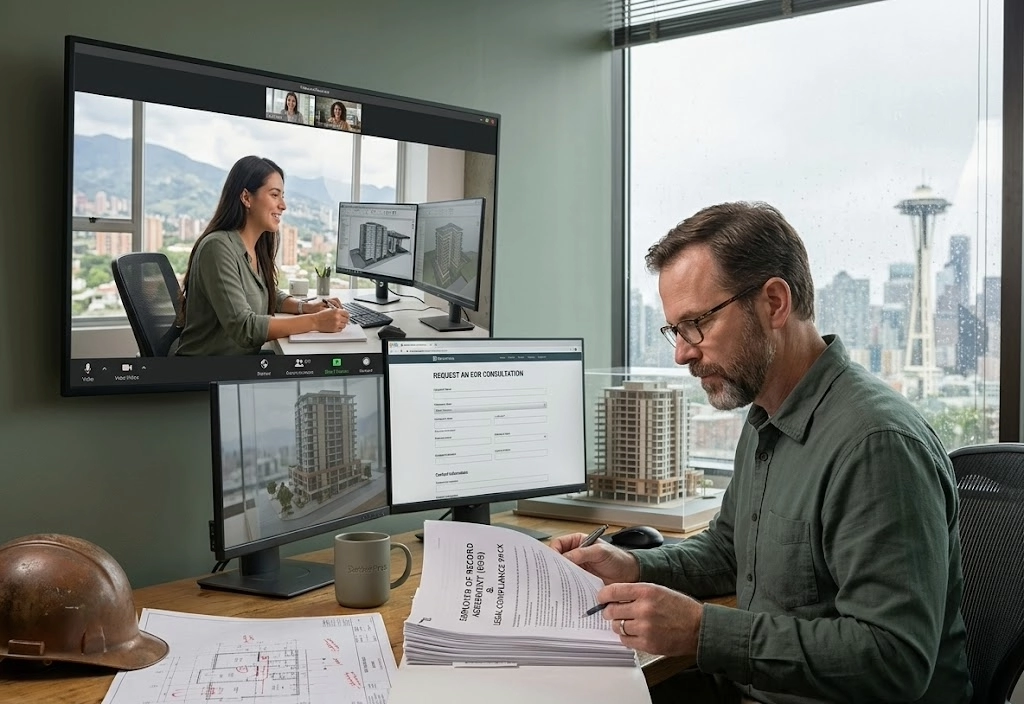
The full picture: what a three-person in-house BIM team costs annually

Pulling all the components together for a mid-size firm running one BIM modeler, one coordinator, and one part-time manager equivalent:

Cost component Annual estimate
Base compensation (3 roles) $238,000 to $309,000
Employer burden, 40% $95,200 to $123,600
Software licenses, 3 seats $10,200 to $12,600
Hardware amortized $1,500 to $4,500
Recruiting (annualized, 1 hire per 2 years) $8,500 to $15,000
Total annual cash cost $353,400 to $464,700
Effective hourly (5,400 hrs, 3 people) $65 to $86/hr

This is cash cost before overhead allocation. Applying a 155% overhead rate to the direct labor component would add approximately $185,000 to $240,000 in indirect costs that the firm must recover through billing. The fully-loaded cost the firm must generate to break even on a three-person BIM team is north of $500,000 per year.

What the nearshore alternative costs

A nearshore BIM team through BetterPros operates on a single all-in hourly rate that covers contractor compensation, Employer of Record costs, and account management. There are no recruiting fees, no benefits administration, no hardware provisioning, and no fixed cost during slow periods. Hours scale with your project load.

The savings structure by role compared to in-house fully burdened cash cost:

Role US in-house burdened hourly Nearshore saving
BIM modeler $44 to $57/hr 50 to 60% below in-house
BIM coordinator $49 to $65/hr 50 to 60% below in-house
BIM manager $61 to $86/hr 45 to 55% below in-house

For the same three-person BIM configuration at 5,400 annual hours, the nearshore model delivers:

In-house annual cash cost Nearshore saving
3-person BIM team, 1,800 hrs each $353,400 to $464,700 50 to 60% below in-house equivalent

The annual difference funds additional capacity, absorbs demand surges without fixed cost risk, or returns directly to the firm's margin.

For current rates specific to your BIM scope, talk to our team.

When in-house makes more sense

The cost comparison does not mean in-house BIM talent is never the right answer. There are specific situations where building internal capacity makes more sense than outsourcing it.

When BIM is a core differentiator for the firm. Some firms compete on the depth and sophistication of their BIM process: parametric design, computational workflows, complex simulation, or BIM-led client deliverables. When BIM capability is central to the firm's positioning and service offer, building internal expertise at the manager and standards level is a strategic investment, not just a production cost.

When the firm has a stable, high-volume project pipeline. The fixed cost argument against in-house staff weakens when demand is consistent and predictable. A firm with a multi-year pipeline and stable annual billings can justify the fixed cost of in-house BIM staff because the utilization risk is low.

When project sensitivity requires full integration. Some project types involve confidentiality requirements, security clearances, or client-specific IT restrictions that make external contractor access to project files complicated. For a minority of AEC engagements, the compliance overhead of external access may outweigh the cost advantage.

When nearshore outsourcing makes more sense

For the majority of US mid-size architecture and engineering firms, the nearshore model resolves the most common production challenge: variable demand against fixed cost.

Firms that benefit most from nearshore BIM talent share a few characteristics. Project load fluctuates across the year, making it difficult to justify full-time staff for peak capacity. Recruiting timelines in their market run long, meaning capacity gaps get filled slowly. The cost of carrying in-house BIM staff through slow periods is visible and painful. And the work itself, primarily Revit modeling, coordination, and documentation, is well-suited to a real-time remote engagement in the same time zone.

The hybrid model is where most mid-size firms end up: one or two internal project leads who own design intent and client relationships, with nearshore BIM talent handling the production volume. The firm gets the continuity and institutional knowledge of a consistent team without carrying the fixed cost of full internal staffing.

Common questions about in-house vs outsourced BIM talent

Does outsourcing BIM work mean losing control of the model?

No, and this is one of the most common concerns firms raise before their first nearshore engagement. Revit Cloud Worksharing through Autodesk Construction Cloud and BIM 360 is designed for distributed teams. Workset permissions, element ownership, and file access are all controlled by your firm. The nearshore coordinator or modeler works within the same permission structure as any remote team member. Your project lead retains full oversight of the model at all times.

How does software licensing work with nearshore BIM contractors?

Your firm provides Revit and Autodesk environment access, the same as you would for any production team member. LATAM contractors provide their own hardware: computer, monitors, and internet connection. The software cost is comparable between in-house and nearshore models. The hardware cost disappears with nearshore.

What happens to the nearshore team during slow periods?

With BetterPros, there are no minimum hours and no lock-in contracts. If project load drops, you scale back hours without carrying fixed headcount costs. If it surges, you scale up without a 60-day recruiting cycle. The model is structured for production flexibility, not fixed commitment.

Is the quality of nearshore BIM work comparable to in-house?

BetterPros vets every contractor before they reach your shortlist, including review of actual Revit documentation samples, model discipline, family quality, and collaborative workflow experience. The contractors placed with US firms have active production experience at the SSr and Sr level. Quality is assessed before the engagement starts, not discovered during it. For a full breakdown of how we evaluate BIM talent, see our BIM coordinator rate and vetting guide.

If you like this content, share it!

💬.png

NEED PROFESSIONALS?